

BIZ HEALTHCARE
Silence at the top costs more than you know
The mental health crisis in your boardroom is not a rumor. It is a business problem nobody is willing to name.
By Vannah Hughes
November 1, 2026
Behind closed executive doors, people are not simply managing stress; they are breaking. Quietly, privately and expensively. As a clinician with 15+ years inside behavioral health systems as well as a former Division I athlete who understands what it means to perform under sustained pressure, I have watched the highest achievers in every industry carry their weight of struggles; however, their public personas were specifically built for concealment. Here is what I know from clinical practice: the person in the corner office may be managing an alcohol dependency that no one at the table would guess. The entrepreneur building her second company may be in the middle of a psychiatric crisis she cannot afford to disclose. The executive who never misses a deadline may be surviving on four hours of sleep and a sexual addiction that has become the only available pressure valve. Alcoholism, depression, anxiety, sex, love, gambling addictions, suicidal ideation, silent rage toward families, and marriages quietly dissolving; these are not the exceptions in high-achieving populations. They are the pattern. And because asking for help has been culturally coded as weakness, the performance continues while the person inside and those around are in deteriorating situations.
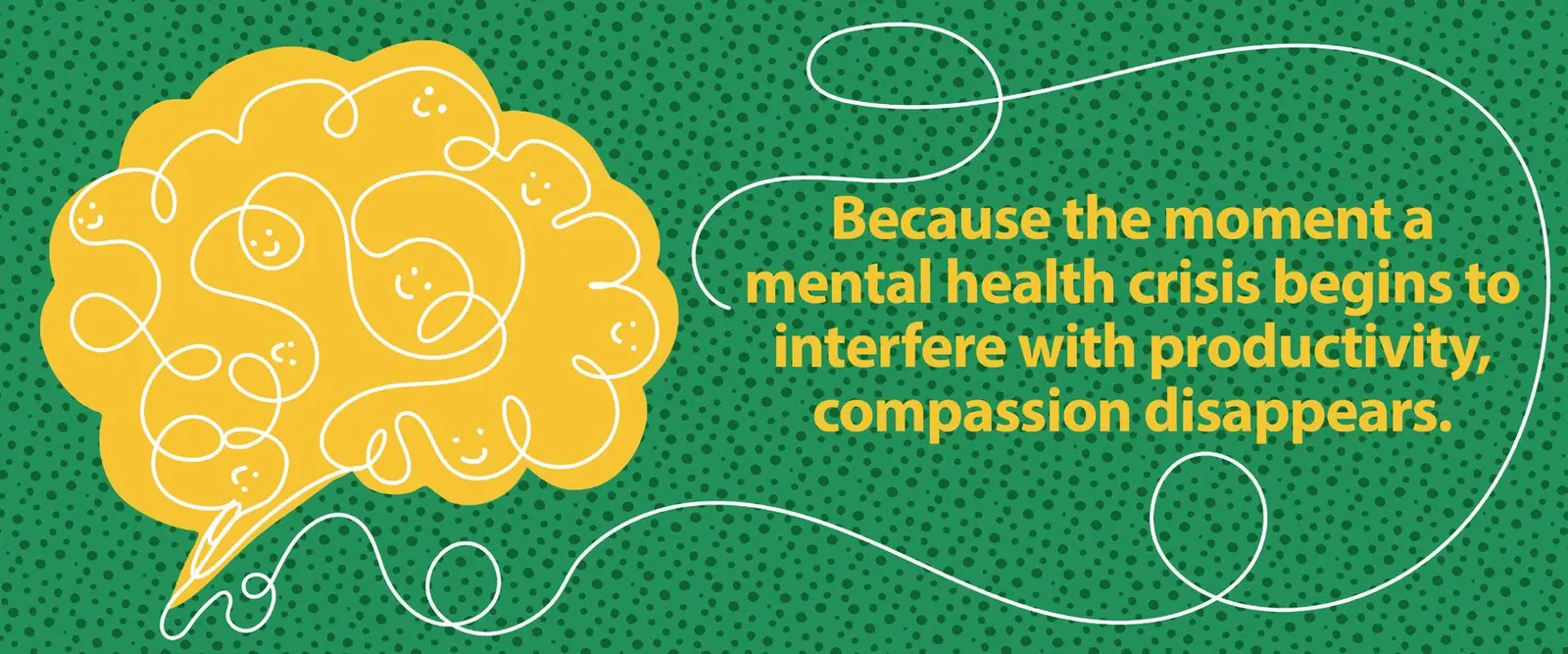
Leaders are suffering at significantly higher rates Organizations across every industry have published wellness initiatives, sent mental health reminders during awareness months, and added employee assistance programs to the benefits portal. They call it a “culture of care.” The more honest question is whether it is “care,” or the performance of care. Because the moment a mental health crisis begins to interfere with productivity, compassion disappears. The employee becomes a liability. The executive becomes a problem to manage. The human being becomes an obstacle between the organization and its quarterly targets. The data is not abstract. Leaders report anxiety and stress at 78%, compared to 58% for their employees. Burnout at 66% versus 45% of employees. Depression at 53% versus 40% for employees, Sleep disruption at 47% versus 30%. These are not minor gaps. Leaders are suffering at significantly higher rates across every measured category, and the organizations they run have not built systems capable of meeting that reality. Only 18.5% of entrepreneurs are aware of the existence of mental health resources that are specifically designed for their needs. Eight sessions of the Employee Assistance Program (EAP) is not mental health care. It is an insult dressed in a benefits package. You cannot compress a collapsing life into eight sessions and call it mental health care. Organizations cannot claim to care about their employees while their infrastructure sends the clear message that their executive team’s value is tied entirely to productivity. The most productive person in your organization may be the one suffering the most. The leaders who run every meeting may be surviving a crisis silently, because naming it would cost them everything they have built.
Look at the people around you Look at the executive who never takes time off, the colleague who is always available and always composed, the leader who holds everything together without apparent effort. Ask, what you are actually seeing? And then ask, what you are refusing to see? When leaders are suffering, the damage does not stay personal. It moves through their teams. Decisions become reactive. Culture becomes unsafe. Employees normalize chaos because the person at the top is quietly drowning in it. That is not a leadership failure in isolation. It is an organizational risk that nobody is willing to name in a board meeting.
Strength has been defined wrong Mental health stigma still sends a damaging message inside every boardroom: seeking help has been coded as weakness! Something to hide, a sign that you cannot handle what you signed up for. So, people wait. They wait until everything has already collapsed before walking into a clinician’s office. This is a reactive crisis. The alternative is preventive care. It’s the steps which an organization takes before the collapse, when the investment costs a fraction of what the breakdown will. Here is the re-frame every high achiever needs to hear: seeking support is not weakness. It is the most precise, strategically sound decision a leader can make. The actual risk is not asking for help. The actual risk is letting it fester, making executive decisions with compromised judgment, depleted capacity and a nervous system quietly running in survival mode. In any other context, ignoring a known and growing organizational risk would be called irresponsible. This is no difference. And when a leader gets real support, the people underneath them feel it: in the quality of decisions and in the safety of the culture. There becomes a steadiness in the environment that they are asked to perform in. Organizations need professional support Executives do not need another performance review, another leadership book, or another wellness webinar. They need real, sustained and clinically informed support from professionals who understand what it costs to carry the weight they carry. And companies that claim to care about their people need to build infrastructure worthy of that claim: not eight sessions, not a hotline number buried in a benefits PDF, but a genuine and ongoing commitment to the mental health of the human beings whose decisions drive the organization. Companies need to be honest. Organizations need to get professional support and get help before their leaders in crisis make decisions they are not mentally competent to do. The question is not whether your organization can afford to invest in the mental health of its leaders. The question is whether you can afford to keep losing them: to quiet breakdowns, voluntary exits, compromised decisions, scandals and the invisible cost of people performing well while privately coming apart.