
BIZ HIGHER EDUCATION
The MBA gets a new assignment
Artificial intelligence, evolving career paths and changing employer expectations are re-shaping the graduate business degree.
November 1, 2026

For generations, a Master of Business Administration has helped professionals move into management, change careers and build valuable business connections. Employers have turned to MBA programs to develop promising executives. Now, artificial intelligence is changing the skills those executives need. As the accompanying 817 Biz ranking shows, North Texas MBA programs vary considerably in enrollment and cost. Enrollment determines each school’s position in the rankings, while program costs provide another point of comparison. But price alone doesn’t determine the value of an MBA.
Is an MBA worth the investment? An MBA can open doors to higher-paying positions, career changes and executive leadership. Whether the investment pays off depends on the program and the student’s career objectives. Tuition at MBA programs ranked by Bloomberg Businessweek increased an average of 11% over four years, according to a March 2026 analysis. Four programs raised tuition at least 20%. Those figures reflect nationally ranked programs, not necessarily the North Texas institutions in the accompanying table. Despite rising costs, the financial returns remain substantial. An Oct. 16 Bloomberg analysis found that the typical projected annualized return on an MBA held at 12.3% over the decade following graduation. The calculation considers educational costs and anticipated additional earnings rather than simply comparing starting salaries. For employees who continue working while pursuing an MBA, the financial equation can be particularly attractive. Scholarships and employer tuition assistance can further reduce out-of-pocket costs. There’s also value beyond compensation. Business school networks can help graduates find new opportunities, while management training can prepare specialists to assume broader responsibilities. For employers considering tuition assistance, an MBA can be one way to develop management talent from within rather than recruit it elsewhere.
How is AI re-shaping the MBA? Artificial intelligence is becoming part of the work managers do every day, from analyzing financial information to assessing market opportunities and improving operations. MBA programs traditionally emphasize finance, marketing, operations, leadership and strategy. Increasingly, graduates also need to understand what AI can accomplish, where it falls short and how to apply its findings to business decisions. The shift is reflected in the Graduate Management Admission Council’s 2026 survey of 621 recruiters and hiring managers across 39 countries. Technology, AI and data analysis skills registered the biggest gains in importance from the previous year. Asked which skills would matter most five years from now, employers placed the ability to use AI tools first, followed by strategic thinking. The findings suggest an advantage for programs that combine technology training with broader management education. Knowing how to generate an AI-assisted financial forecast is useful; understanding its assumptions and deciding what to do with the results requires judgment. For prospective students and employers evaluating MBA programs, the relevant question is how thoroughly AI is incorporated into courses such as finance, marketing and business strategy—not simply whether a university offers a separate technology degree.
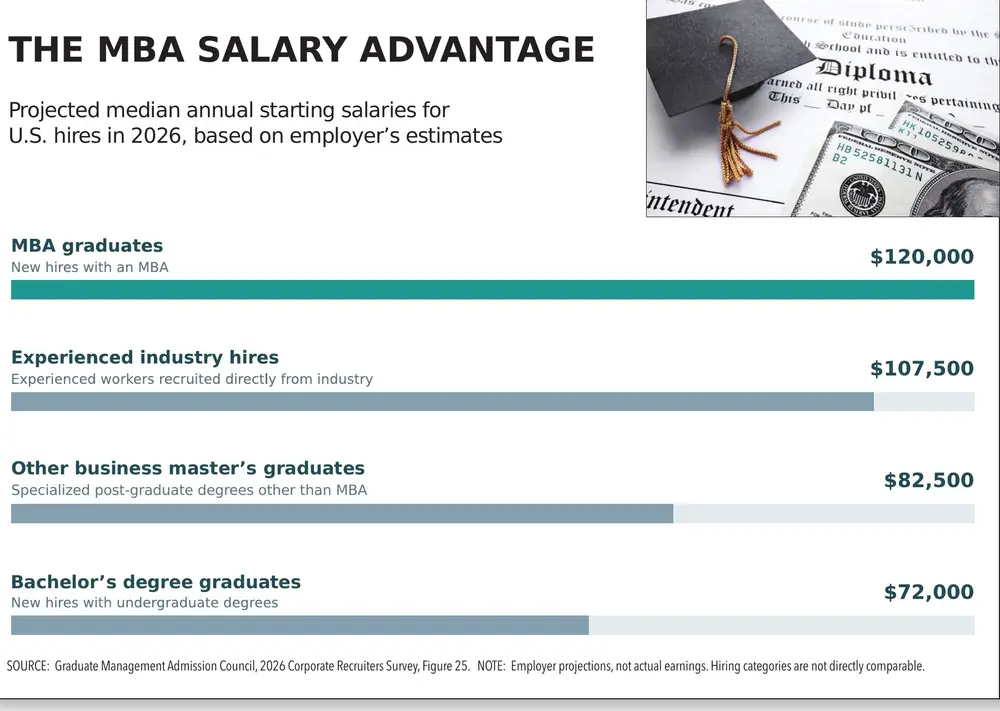
Where does an MBA open doors? Employers continue to place financial value on graduate business education. GMAC’s 2026 survey projected a median annual starting salary of $120,000 for newly hired MBA graduates in the United States. That compares with $72,000 for bachelor’s degree graduates and $107,500 for experienced professionals recruited directly from industry. These are employer projections, not actual salaries paid, and the differences cannot be attributed solely to an MBA. While technical skills are gaining ground, the survey found that employers still place considerable importance on traditional management capabilities. Communication was cited by 64% of respondents, followed by problem-solving at 62% and adaptability at 60%. The way students earn their degrees is changing, too. GMAC found that 61% of surveyed employers valued online and in-person graduate management programs equally, up from 55% two years earlier. That could be encouraging news for working professionals who want to pursue an MBA without leaving their jobs or relocating. For employers, sponsoring an employee’s MBA can provide an opportunity to develop future leaders. For individuals seeking advancement or a new career direction, the degree offers a combination of business knowledge, professional relationships and management credentials. The choice ultimately comes down to finding a program that fits the career goal, the schedule and the budget.